


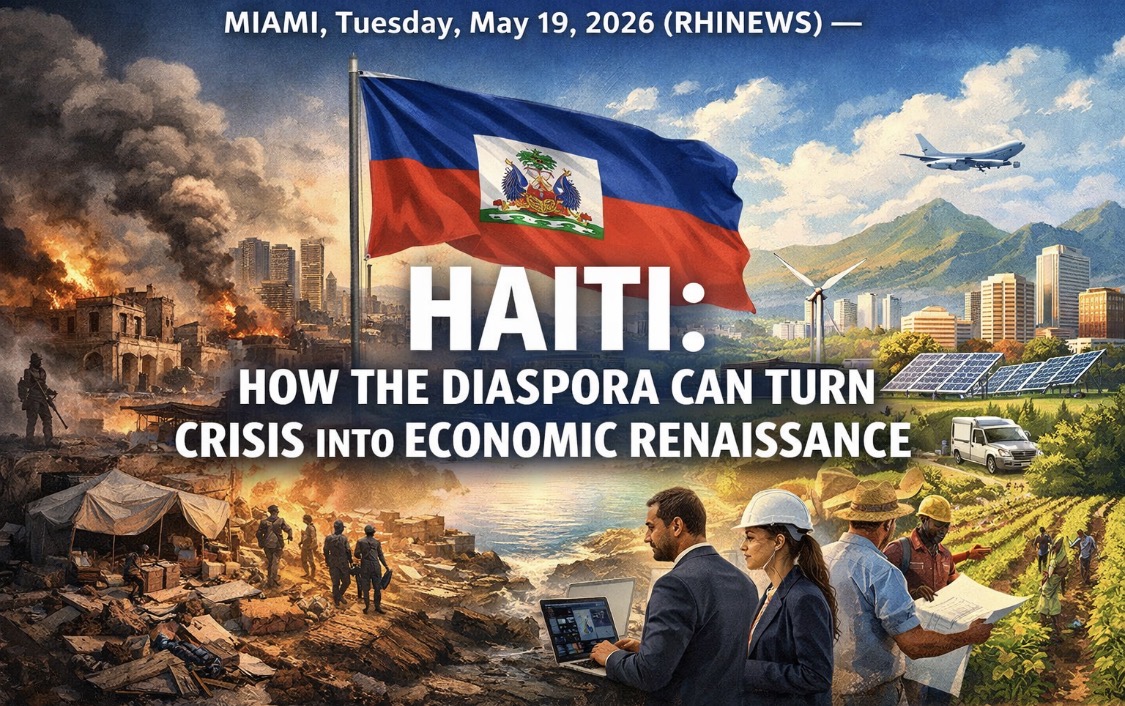
Amid worsening insecurity, institutional paralysis, and an unprecedented economic crisis, Haiti appears to be standing on the edge of collapse. Yet beneath this turmoil also lies a vast field of economic, technological, and productive opportunities. Backed by its financial power, international expertise, and growing economic influence, the Haitian diaspora could now play a historic role by transforming the country’s current breakdown into a catalyst for national reconstruction and economic rebirth.
By Francklyn B. Geffrard,
MIAMI, Tuesday, May 19, 2026 (RHINEWS)-Haiti is now widely portrayed as a country overwhelmed by insecurity, institutional collapse, poverty, brain drain, and economic disintegration. Yet behind this dramatic reality lies another truth that is rarely discussed: never in the country’s modern history have so many economic, technological, industrial, agricultural, and financial spaces been simultaneously open to creation, innovation, and investment. Where some only see a collapsing nation, others can already see one of the largest reconstruction markets in the Caribbean, a country filled with unmet needs waiting for practical solutions.
The Haitian paradox is precisely this: the deeper the collapse, the greater the needs; the greater the needs, the larger the opportunities to build solutions. Haiti lacks electricity, making solar energy a massive market. Haiti lacks agricultural production, making modern farming strategically essential. Haiti lacks digital services, making technology and online platforms almost untouched sectors. Haiti lacks modern banking infrastructure, making fintech, mobile payments, and alternative financial systems indispensable. Haiti lacks safe housing, making smart construction and modern urban planning sectors of the future. Haiti lacks data centers, logistics systems, storage facilities, reliable telecommunications, modern healthcare services, and organized distribution networks. Every national deficiency potentially represents an entire industry waiting to be built.
In developed economies, markets are already saturated and dominated by giant corporations. In Haiti, entire sectors remain largely empty. This situation represents enormous risk, but also a historic opportunity for those capable of delivering practical solutions to real problems. Nations are often rebuilt during their darkest periods. Economic history repeatedly shows that many industrial powers emerged from chaos, war, or institutional breakdown. Crises destroy societies, but they also create new spaces for builders.
The Haitian diaspora now holds a tremendous strategic advantage. Its power lies not only in the money it sends home, but also in the experience acquired abroad, the mastery of modern technologies, organizational discipline, international networks, entrepreneurial culture, and the ability to connect Haiti to global markets. Remittances from Haitians abroad already represent one of the pillars of the country’s survival. In 2024, remittances to Haiti exceeded 4.1 billion US dollars and represented more than 20 percent of the country’s GDP. These flows support millions of families despite economic collapse.
Yet the real historical question is now this: will the diaspora continue merely financing family survival, or will it finally begin financing production, innovation, and national reconstruction? For decades, a large share of diaspora resources has gone toward food, rent, school fees, and medical expenses. These transfers are essential, but they are insufficient to structurally transform the Haitian economy. Haiti now needs a major transition: from an economy dependent on remittances to an economy driven by productive investment.
This transformation becomes even more urgent in light of Haiti’s massive brain drain. Haiti suffers from one of the world’s most severe losses of skilled labor. According to widely cited estimates, nearly 85 percent of Haitian university graduates eventually leave the country. Doctors, engineers, programmers, teachers, managers, entrepreneurs, and technicians migrate to North America, Europe, or neighboring Caribbean territories in search of stability and opportunity. This exodus deprives Haiti of its most valuable human capital. Yet this phenomenon could also become a force for reconstruction if the diaspora stops operating in a fragmented and emotional manner and becomes organized, strategic, and institutionalized.
This is precisely why the creation of a major diaspora investment bank has become a historic necessity. Haiti’s banking system remains extremely limited when it comes to productive credit. Small and medium-sized businesses have very limited access to financing. Interest rates are often prohibitive. Technology startups have virtually no access to venture capital. Young agricultural entrepreneurs lack modern funding mechanisms. Under such conditions, thousands of ideas die before they are even born.
An investment bank created by Haitian expatriates could become the engine of a new national economy. Such an institution could mobilize diaspora savings, finance small and medium-sized enterprises, support modern agricultural projects, invest in digital technologies, provide credit to innovative startups, and fund strategic infrastructure in energy, telecommunications, and logistics. It could also create specialized investment funds for smart agriculture, renewable energy, fintech, digital healthcare, modern construction, and community infrastructure.
The goal would not simply be to lend money, but to create an entire development ecosystem. This institution could finance technology incubators, technical training centers, innovation laboratories, and digital platforms capable of connecting Haiti to the global economy. It could also develop modern microfinance mechanisms, mobile payment systems, and collective digital investment platforms allowing the diaspora to directly participate in productive projects.
Haiti is now an enormous field for technological innovation because its structural deficiencies force society to invent new solutions. The lack of stable electricity pushes the country toward solar microgrids. Weak banking infrastructure accelerates fintech and mobile money adoption. Limited access to education creates major opportunities for online learning platforms. Healthcare shortages open the door to telemedicine. Logistical difficulties encourage innovation in drones, geolocation, and smart supply chains. The constraints themselves become drivers of innovation.
One concrete example could involve a diaspora consortium financing community solar microgrids across relatively stable secondary cities. The project could include training local technicians, installing smart batteries, implementing mobile payment systems, and creating regional maintenance centers. Such an initiative would reduce energy dependency, create jobs, stimulate local commerce, and generate sustainable returns for investors.
Another example could involve building a modern agro-industrial network combining farming, solar-powered cold storage, food processing, and digital distribution systems. Diaspora investors could finance agricultural cooperatives using smart irrigation, agricultural drones, and online commercialization platforms. Processed products could serve local markets while also targeting Haitian communities abroad. Such a model would reduce food imports, increase rural incomes, and create a national value chain.
However, no serious transformation can succeed without discipline, transparency, and strategic vision. One of Haiti’s greatest historical weaknesses has often been permanent improvisation. Haiti does not simply lack money. It lacks organization, modern governance, institutional trust, and economic discipline. Emotional, improvised, or poorly structured investments usually fail rapidly. National reconstruction instead requires strong pilot projects, serious market studies, adapted security systems, independent audits, and transparent management mechanisms.
Haiti’s youth must also become the core of this new economy. The country possesses a large, energetic, and creative young population, but many lack technical skills adapted to the modern world. The priority should be the large-scale creation of training centers focused on artificial intelligence, coding, cybersecurity, renewable energy, smart agriculture, logistics, and industrial maintenance. A modern economy is not built solely with capital. It is built above all with skills.
Haiti now stands at a historic crossroads. The country can continue sinking into dependency, mass migration, and gradual collapse, or it can transform its current crisis into the starting point of an unprecedented economic rebirth. The Haitian diaspora likely represents one of the greatest reservoirs of financial, intellectual, and human capital in the nation’s history. If this force remains fragmented, Haiti will probably continue to decline. But if it becomes organized, strategic, and focused on productive investment, it could transform the country more profoundly than decades of international aid ever have.
Haiti’s future may depend less on foreign powers than on Haitians’ own ability to finally build a productive, technological, modern, and sovereign economy. The real question is no longer whether Haiti is in crisis. The real question is whether Haitians will have the historic courage to transform this crisis into the foundation of a new economic nation.